Mervyn M. Dymally Collaboration
Learn more about the collaboration to build this curriculum.
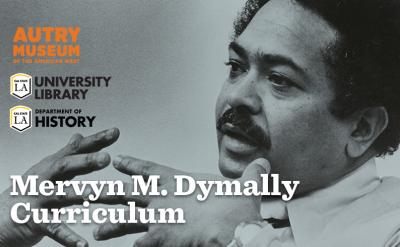
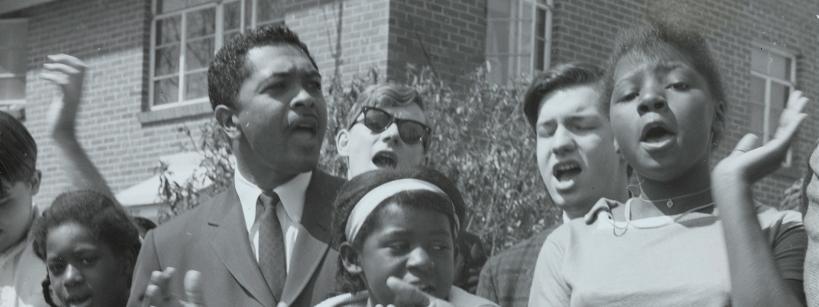
During this What Can Sources Teach Us? lesson, students will learn about public educator, politician, and California State University, Los Angeles alumnus Mervyn M. Dymally (1926-2012). Students will also learn about Mervyn M. Dymally’s participation in the Selma to Montgomery Marches by analyzing primary and secondary sources, reading, writing, and completing a mapping activity. Students will then create and share their own primary and secondary sources that tell their stories.
Standards
Lesson and Resources
Lesson - What Can Sources Teach Us? - English
Lesson - What Can Sources Teach Us? - Spanish
Student Response Sheet - What Can Sources Teach Us? - English
Student Response Sheet - What Can Sources Teach Us? - Spanish
Associated Education Resources
Curriculum: Mervyn M. Dymally Project
Exhibition: Mervyn M. Dymally: The Bridge-Builder of Los Angeles
Lesson: Who was Mervyn M. Dymally?
Video: Autry Artists Salon on Autry Classroom Curators - Mervyn M. Dymally Archives Project
Teaching Tips for Different Learning Environments
Whole Class Learning for Grade 3:
Whole Class Learning for Grades 4-5:
Learn more about the collaboration to build this curriculum.





Molly and Neal Brockmeyer · David F. Eisenberg · The Georgina-Fredrick Children's Foundation · The Max and Victoria Dreyfus Foundation · Christy McAvoy · Robert E. Ronus · Brenda and Gary Ruttenberg · The Steinmetz Foundation · Virginia F. Stevenson · Thelma Pearl Howard Foundation
The Autry Museum of the American West acknowledges the Gabrielino/Tongva peoples as the traditional land caretakers of Tovaangar (the Los Angeles basin and So. Channel Islands). We recognize that the Autry Museum and its campuses are located on the traditional lands of Gabrielino/Tongva peoples and we pay our respects to the Honuukvetam (Ancestors), ‘Ahiihirom (Elders) and ‘Eyoohiinkem (our relatives/relations) past, present and emerging.
4700 Western Heritage Way
Los Angeles, CA 90027-1462
In Griffith Park across from the Los Angeles Zoo
Map and Directions
Free parking for Autry visitors
MUSEUM AND STORE HOURS
Tuesday–Friday 10:00 a.m.–4:00 p.m.
Saturday–Sunday 10:00 a.m.–5:00 p.m.
DINING
Food trucks are available on select days, contact us for details at 323.495.4252.
The cafe is closed temporarily until further notice.