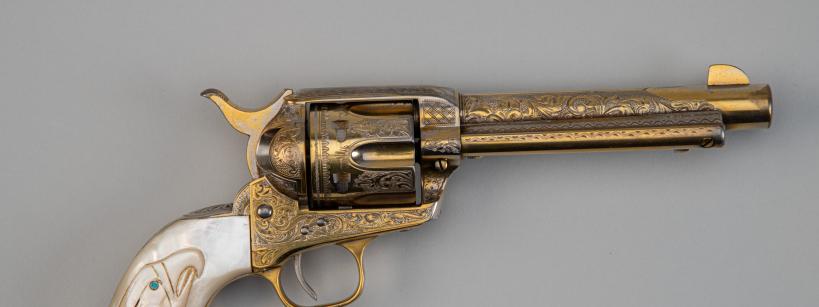
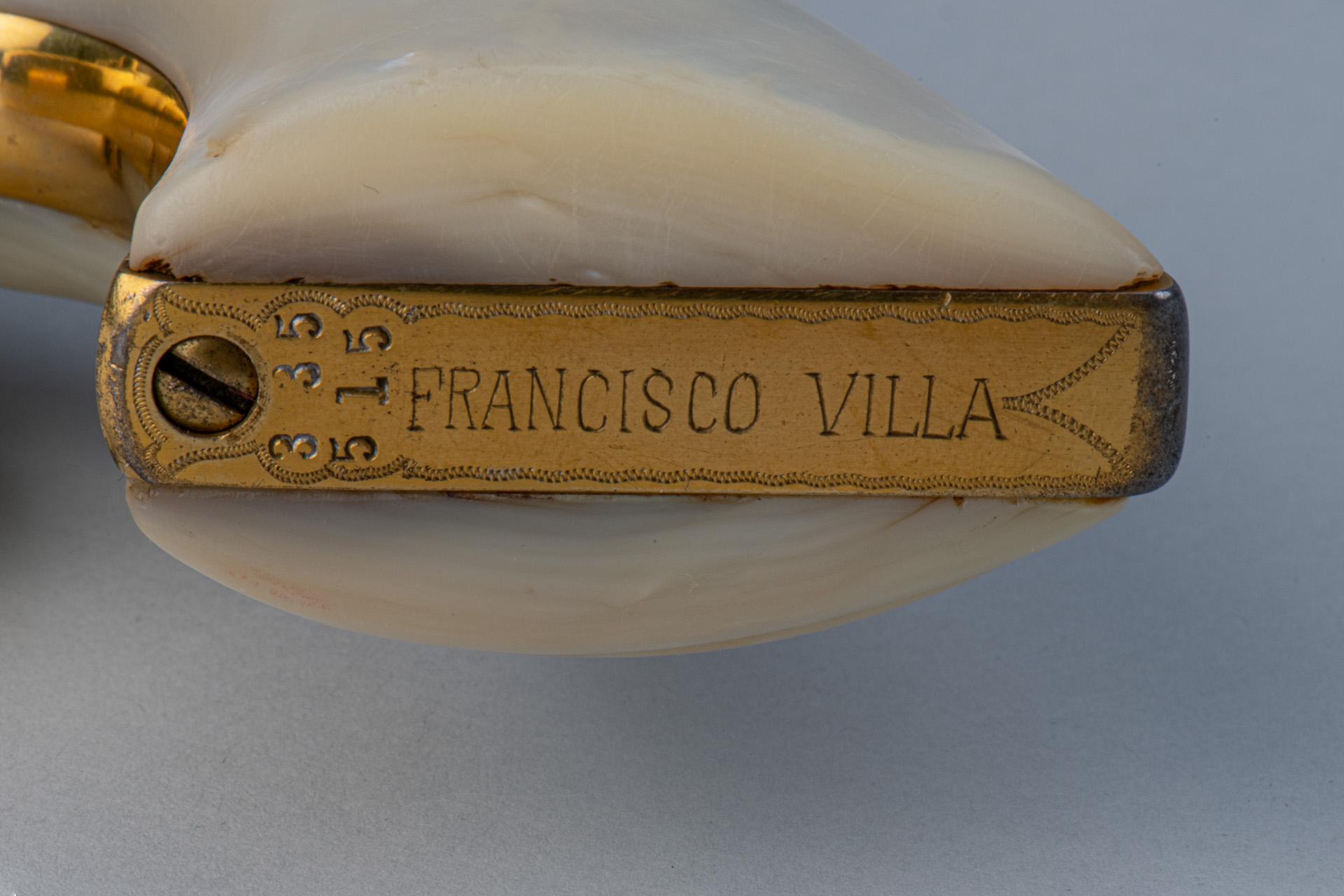
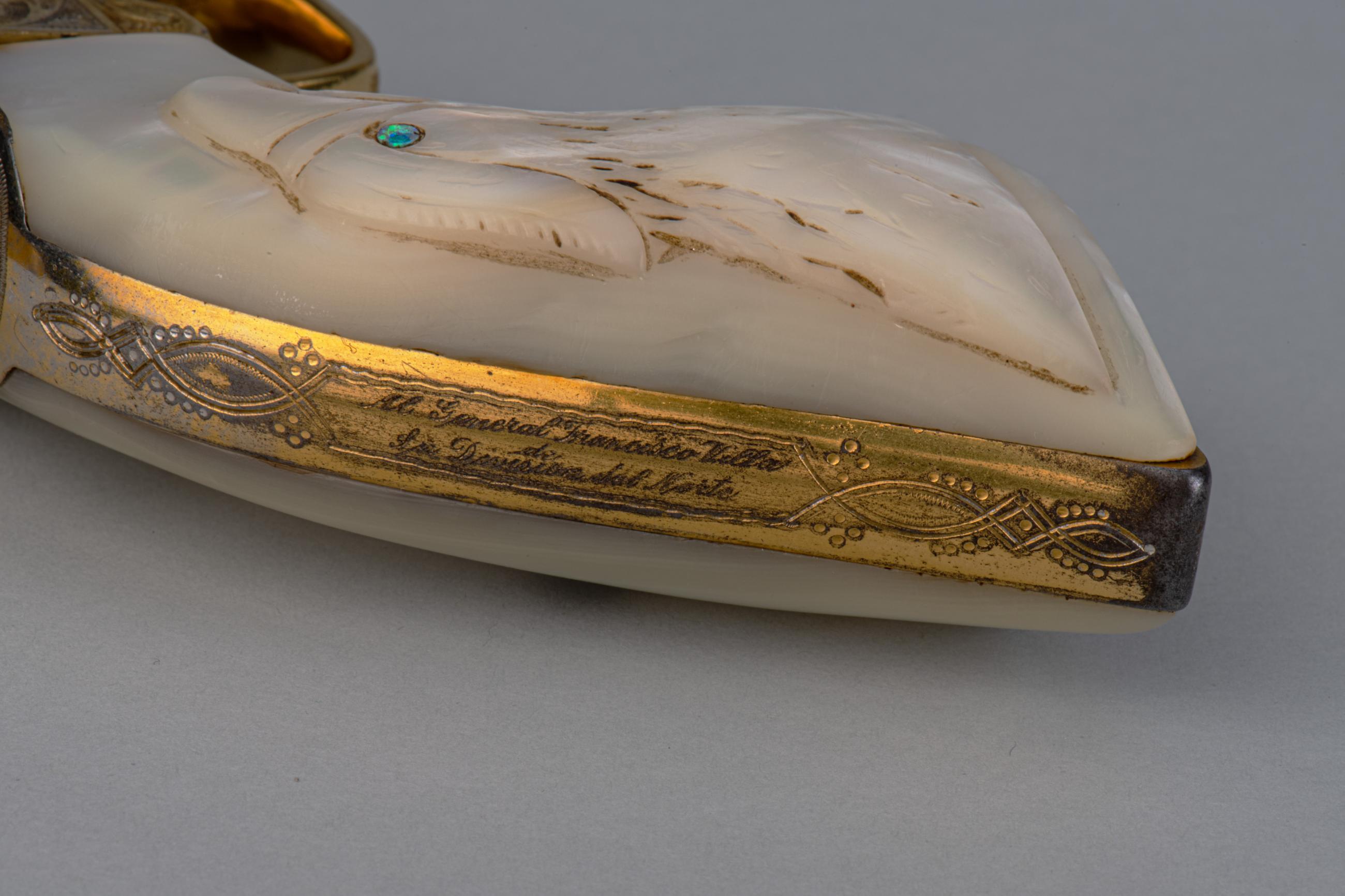
[Right profile detail] Colt Single-Action Army revolver, .45 caliber, 1917. Metal, gold-plating, pearl inlay, and opal inlay. Gift of George Gamble. Autry Museum; T2025-50-2
By Marion Leathers-Bonnet, Acquisitions Registrar
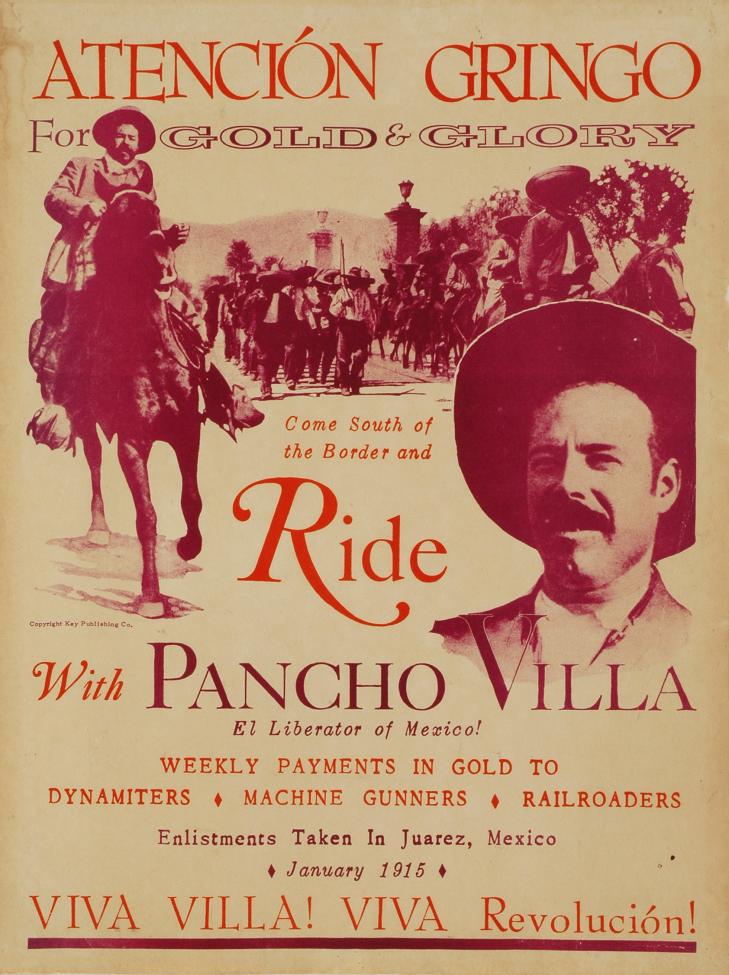
Walking through the galleries of the Autry Museum, visitors encounter many legendary figures of the West, but few, such as Francisco “Pancho” Villa (1878–1923), hold the status of both folk hero and outlaw. The Mexican revolutionary leader who led the Northern Division and briefly served as governor of Chihuahua inspired both admiration and fear.
Recruitment poster, 1915. Lithograph. Printed by Key Publishing Company. Acquisition made possible in part by John E. Bianchi Jr. Autry Museum; 85.1.1656
Through newspapers, photographs, and films, he carefully crafted his own image, drawing recruits and sympathizers on both sides of the border. So, when in July 2025, a Colt Single-Action Army revolver bearing the inscriptions “Al General Francisco Villa/de/su Division del Norte” and “FRANCISCO VILLA” arrived at the Autry as an offered donation, an investigation into its history immediately began.
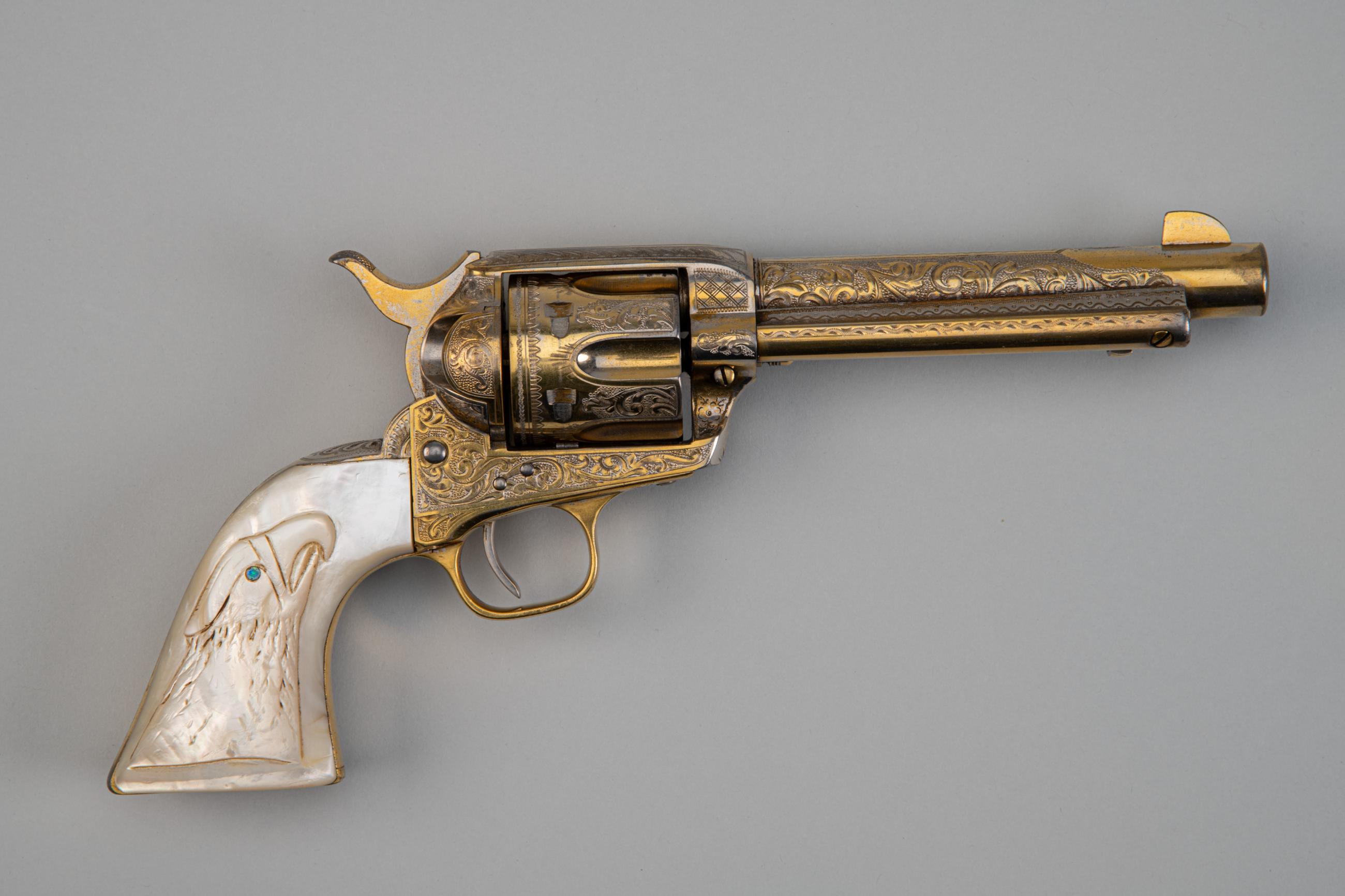
[Right profile] Colt Single-Action Army revolver, .45 caliber, 1917. Metal, gold-plating, pearl inlay, and opal inlay. Gift of George Gamble. Autry Museum; T2025-50-2
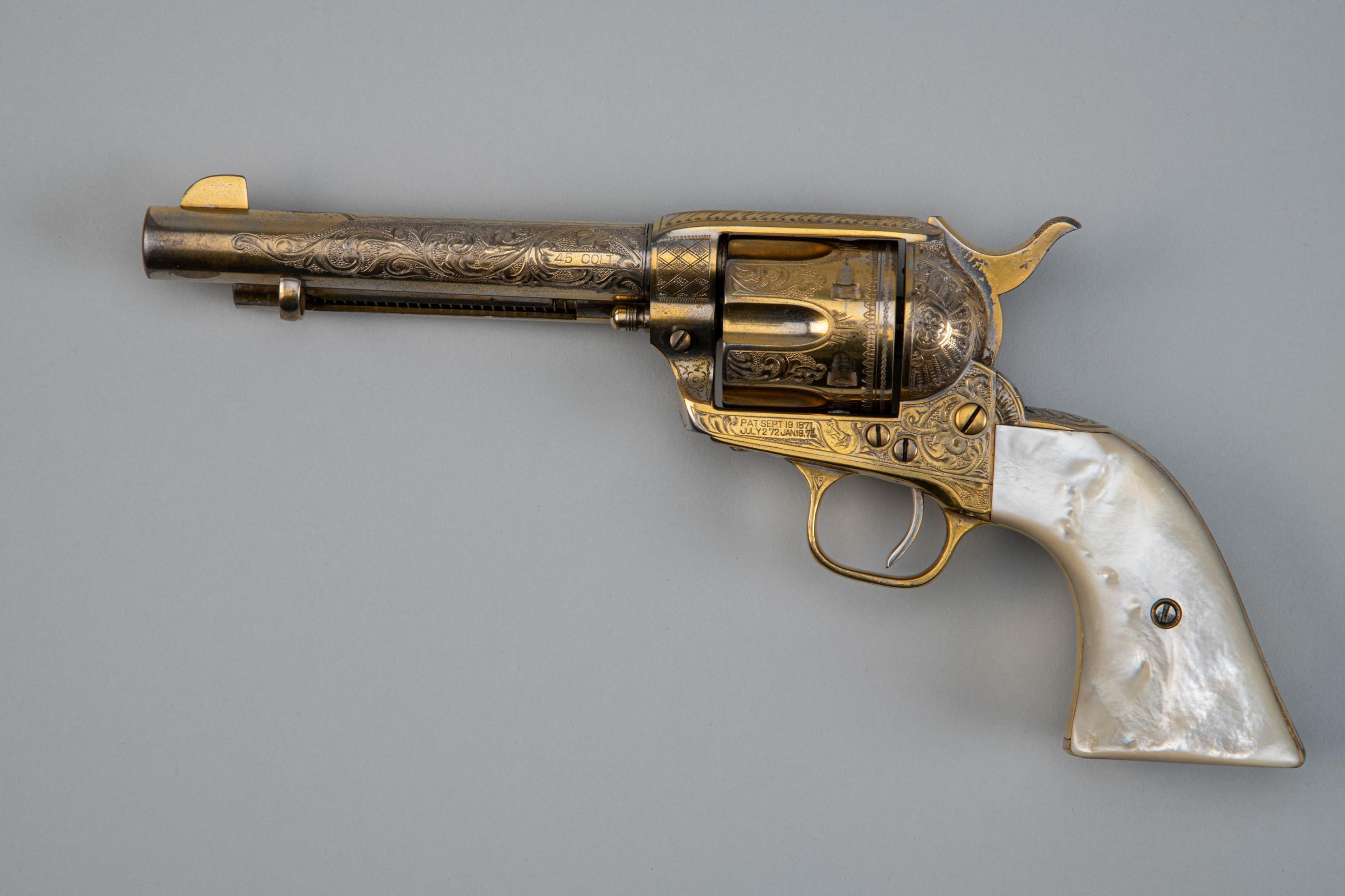
[Left profile] Colt Single-Action Army revolver, .45 caliber, 1917. Metal, gold-plating, pearl inlay, and opal inlay. Gift of George Gamble. Autry Museum; T2025-50-2
[Detail] Colt Single-Action Army revolver, .45 caliber, 1917. Metal, gold-plating, pearl inlay, and opal inlay. Gift of George Gamble. Autry Museum; T2025-50-2
[Detail] Colt Single-Action Army revolver, .45 caliber, 1917. Metal, gold-plating, pearl inlay, and opal inlay. Gift of George Gamble. Autry Museum; T2025-50-2
Among the first documents consulted were factory letters from Colt's Manufacturing Company, which indicated that this .45 caliber revolver, with a 5½ inch barrel, was manufactured with a striking gold finish and elaborate scrollwork on the barrel, cylinder, frame, and trigger guard. They also noted that the firearm was purchased as a single item, suggesting a valuable custom order. While the inscriptions are not mentioned, they may still be contemporary of the period. In 1917, Pancho Villa was a famous figure, although highly divisive, and the inscriptions may have been added shortly before the firearm was presented to him.
Factory records further show that the revolver was purchased by Shapleigh Hardware Co. of St. Louis and shipped to City Loan & Jewelry Co. on April 18, 1917. The latter was a pawnshop founded and operated by Joseph B. Ravel (1884–1957) in El Paso, a rough border town. In a 1968 interview with the University of Texas at El Paso, Joseph’s son, Vincent Ravel, recalled that his father had “business dealings” with Pancho Villa and knew him as a “good customer.”
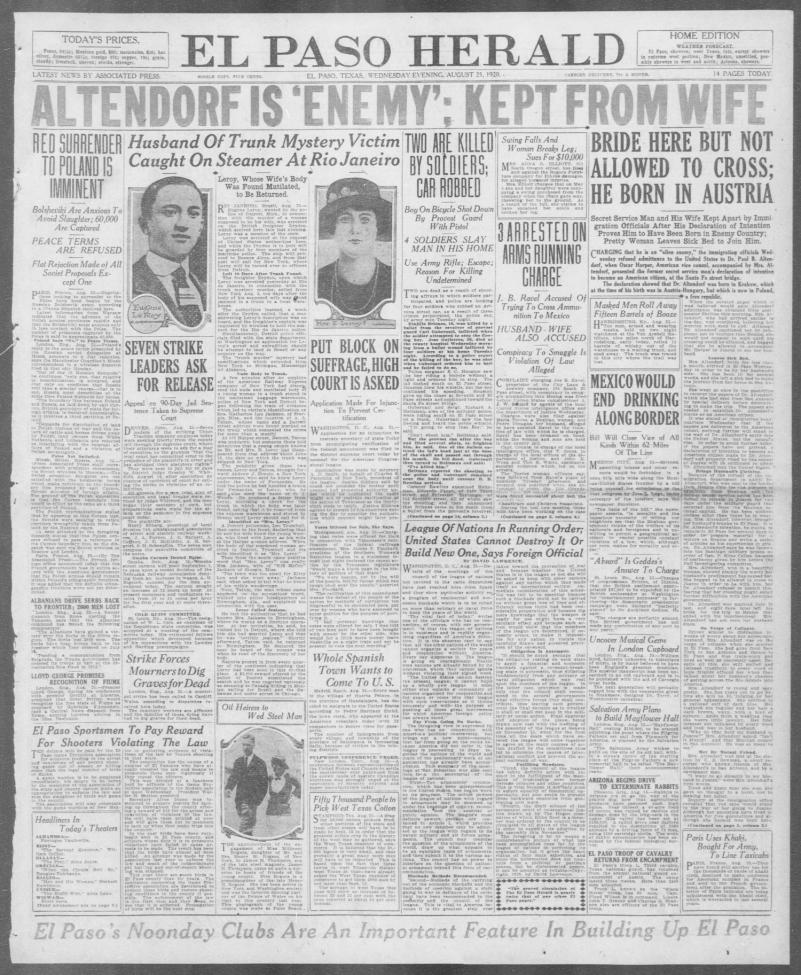
Slater, H. D. El Paso Herald (El Paso, Tex.), Ed. 1, Wednesday, August 25, 1920, newspaper, August 25, 1920; El Paso, Texas. (https://texashistory.unt.edu/ark:/67531/metapth137754/: accessed April 16, 2026), University of North Texas Libraries, The Portal to Texas History, https://texashistory.unt.edu
The El Paso Heraldalso gives an idea of Joseph’s activities, describing his multiple arrests in 1913, 1915, and 1920 for smuggling ammunition across the border. Joseph’s nephew, Sam Ravel, an arms dealer and cofounder of the shop, is believed to have had his own connection with Villa. Historians James A. Sandos and Thomas Boghardt agree that the dispute between them was one of the determining factors behind the infamous 1916 raid on Columbus.
Shapleigh Hardware Co., the gun’s buyer, was a successful hardware wholesaler used to acquire firearms in bulk. Yet a gold-plated revolver obtained as a single item from Colt’s fell outside the company’s usual business practices. Its president until 1913, Saunders Norvell also sat on the board of a St. Louis bank, the Mississippi Valley Trust Co. The bank held accounts managed by Felix A. Sommerfeld, a double agent working for both Pancho Villa and the German government. This connection is noteworthy considering that, just twelve days before the gun was purchased, the United States had declared war against Germany, following its attempt to involve Mexico in the conflict through the Zimmermann Telegram. After 1917, however, the revolver is unaccounted for, and it is only in 1958 that it reappears in a private collection. This forty-one-year gap is a significant break in the provenance records.
At the time of writing, Pancho Villa's ownership of the gun cannot be indisputably proven, and important questions remain, including the possibility of German financial involvement. Nevertheless, the elements linking the firearm to the revolutionary leader are noteworthy. Authentic or otherwise, the story is worth telling, and visitors will soon be able to see the golden Colt in the galleries of the Autry Museum alongside Theodore Roosevelt’s revolver and Annie Oakley’s shotgun. In the meantime, the investigation continues.
The Autry Museum of the American West acknowledges the Gabrielino/Tongva peoples as the traditional land caretakers of Tovaangar (the Los Angeles basin and So. Channel Islands). We recognize that the Autry Museum and its campuses are located on the traditional lands of Gabrielino/Tongva peoples and we pay our respects to the Honuukvetam (Ancestors), ‘Ahiihirom (Elders) and ‘Eyoohiinkem (our relatives/relations) past, present and emerging.
Autry Museum of the American West
4700 Western Heritage Way Los Angeles, CA 90027-1462 In Griffith Park across from the Los Angeles Zoo Map and Directions
Free parking for Autry visitors
MUSEUM AND STORE HOURS Tuesday–Friday 10:00 a.m.–4:00 p.m. Saturday–Sunday 10:00 a.m.–5:00 p.m.
DINING Food trucks are available on select days, contact us for details at 323.495.4252. The cafe is closed temporarily until further notice.