Of Life, Liberty, and Los Angeles

Topics: The View From Here

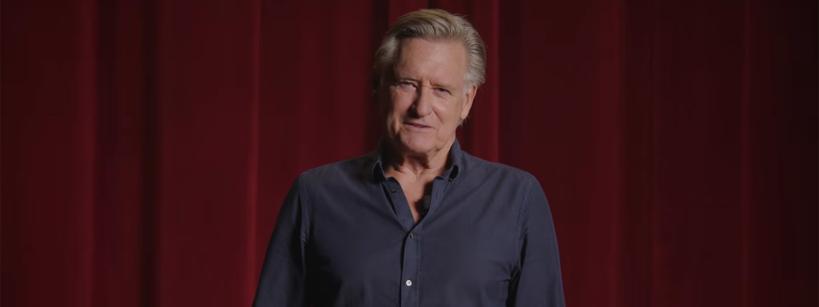
A man with gray hair wearing a navy shirt stands in front of red theater curtains, looking at the camera and smiling gently.

Bill Pullman reads the Declaration of Independence 

By Stephen Aron, Calvin and Marilyn Gross Director and President and CEO

By the time you read this, it will have been five years since I took the reins at the Autry.  I could reflect on lots of matters, but it is the exhibition currently on view in the Marilyn and Calvin Gross Gallery that commands my attention. That’s because I announced two entwined goals when I became the director of the Autry Museum of the American West. First, the Autry would explore what the West—past, present, and future—looks like from the perspective of Los Angeles. Second, we would bring that sightline to bear on the national commemoration of the 250th anniversary of the Declaration of Independence. With the Life, Liberty, and Los Angeles exhibition, we offer “the view from here” on the Declaration’s animating ideals. And, as part of the larger “LA2026” project outlined below, the Autry has its say and enters the fray in the nation’s semi-quincentennial conversation. 

The Declaration of Independence contains only 1,337 words, but millions and millions of thoughts have been written and spoken about that document since it was penned and signed 250 years ago. If you want to hear the entire Declaration read, please watch Bill Pullman’s oration below or in the lobby at the Autry Museum. My thanks to Bill for this recording and for meeting the challenges posed by the pronunciation of the word “consanguinity.”

Bill Pullman Reads the Declaration of Independence

Most famous of all and most written and spoken about are the thirty-six words that compose the Declaration’s second sentence, which the historian Walter Isaacson recently deemed “the greatest sentence ever written.”: “We hold these truths to be self-evident, that all men are created equal, that they are endowed by their creator with certain unalienable rights, that among these are life, liberty, and the pursuit of happiness.”

The Autry’s exhibition, brilliantly curated by Senior Curator Carolyn Brucken, takes its title from that greatest sentence. The conventional 250th anniversary exhibition would start with what those words meant to Jefferson and the other signers of the Declaration in the Second Continental Congress (which was anything but continental in its constituency or its outlook). Our exhibition, by contrast, examines the meaning and impact from the other side of the continent. It takes the view from here to see how the pursuits of life, liberty, and happiness have shaped the development of Los Angeles over the last 250 years.

I acknowledge that not all shared my enthusiasm for this perspective and this project. Indeed, up until five years ago, I would have disputed the salience of the view from here. Almost all my writing and teaching about the American West and its history took a westward angle of vision. I was convinced, however, that the Autry had to make the West more immediate and relevant for local audiences. To make the museum matter more to more people in Southern California, we had to showcase the West not as something thought of as “out there and back then” but also as rooted in the “here and now.” As I’ve pursued this excursion, I’ve come to better understand how often developments in Los Angeles anticipated, exemplified, and exaggerated what happened across the West and the United States.

Our exhibition stands on its own, but its standing is enhanced by being part of the LA2026 consortium which, with generous funding from the National Endowment for the Humanities, supports programming at the Autry and five other institutions around greater Los Angeles. We are delighted to stand with The Huntington Library, La Plaza, the LA County Natural History Museum, San Gabriel Mission, and the USC Library. And we are grateful to the USC-Huntington Early Modern Studies Institute for enabling us to hang together so that, to quote Benjamin Franklin, we shall not hang separately. 
Land Acknowledgment

The Autry Museum of the American West acknowledges the Gabrielino/Tongva peoples as the traditional land caretakers of Tovaangar (the Los Angeles basin and So. Channel Islands). We recognize that the Autry Museum and its campuses are located on the traditional lands of Gabrielino/Tongva peoples and we pay our respects to the Honuukvetam (Ancestors), ‘Ahiihirom (Elders) and ‘Eyoohiinkem (our relatives/relations) past, present and emerging.

Autry Museum of the American West

4700 Western Heritage Way
Los Angeles, CA 90027-1462
In Griffith Park across from the Los Angeles Zoo
Map and Directions

Free parking for Autry visitors


MUSEUM AND STORE HOURS
Tuesday⁠–⁠Friday 10:00 a.m.–4:00 p.m.
Saturday–Sunday 10:00 a.m.–5:00 p.m.

DINING
Food trucks are available on select days, contact us for details at 323.495.4252.
The cafe is closed temporarily until further notice.